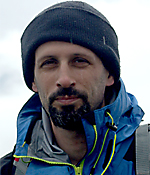
Prof Ian M. Brooks
Institute for Climate & Atmospheric Science
School of Earth & Environment
University of Leeds
Leeds, LS2 9JT, UK
email: i.brooks@see.leeds.ac.uk
phone: +44(0)113-343-6743
fax: +44(0)113-343-5259

|
Prof Ian M. Brooks
|
My research interests lie mostly within the area of boundary-layer meteorology and turbulent exchange processes - air-sea interaction, entrainment, and polar boundary layers - straying occasionally into aerosol and cloud microphysical processes. While primarily an experimental/observational scientist, I have become increasingly involved with modelling studies, using large eddy simulation to study boundary-layer processes directly, and confronting large-scale models with measurements to try and figure out why they don't work as well as we'd like them to.
Publications | Conference papers | C.V. | Fieldwork Blog | Scopus | Google Scholar
CURRENT RESEARCH PROJECTS
Arctic Cloud Summer Expedition (ACSE)
A collaboration between Leeds, the University of Stockholm, and NOAA-CIRES - ACSE aims to study the response of Arctic boundary layer cloud to changes in surface conditions in the Arctic Ocean. Based on the Swedish Icebreaker Oden for a 3-month cruise from Tromso, Norwayto Barrow, Alaska and back over the summer of 2014 we are measuring surface turbulent exchange, boundary layer structure, and cloud properties. Many of the measurements use remote sensing approaches - radar, lidar, and microwave radiometers - to retrieve vertical profiles of thedynamic and microphysical properties of the lower atmosphere and cloud.
[NERC grant: NE/K011820/1]
High Wind Gas Exchange Study (HiWinGS)
A NERC funded collaboration between Leeds, the National Oceanography Centre (Robin Pascal), and the University of Southampton (Helen Czerski, Timothy Leighton, and Steve Gunn). This is a contribution to a US project to study the exchange of gases (CO2, CO, DMS, and maybe others) between the ocean and atmosphere at high wind speeds where wave breaking and bubbles become important factors. We will be deploying an 11-m spar buoy, designed and built at NOC for a previous SOLAS study, instrumented to measure wave spectra, wave breaking, and bubbles in the upper ocean; the surface coverage of whitecaps, and sea-spray aerosol fluxes. US teams from the University of Hawai'i (Barry Huebert and Jeff Hare) and NOAA (Chris Fairall) will measure gas fluxes. Other teams have proposals pending to add further measurements to the cruise, schuduled to take place in October/November 2013.
Blowing snow and sea ice surfaces as a source of polar sea salt aerosol (BLOWSEA)
The concentration of salt in ice cores has been proposed as a sea ice proxy for use in assessing past climate - several lines of evidence suggest that sea salt aerosol generated from the sublimation of blowing snow over sea ice is the major source of salt in the cores. While this has been applied by a number of studies of past climate, without quantification of the source it is difficult to specify exactly what aspect of sea ice is being recorded within the ice core. This study will characterise the rate of production of sea-salt aerosol from the evaporation of blowing snow over sea ice and provide a means to quantify the deposition rate to glacial ice in the past and thus constrain past climate conditions inferred from the salt concentration in ice cores. BLOWSEA is led by Eric Wolf at the British Antarctic Survey (BAS) in collaboration with Anna Jones (BAS), Phil Anderson (SAMS), and John Pyle and Xin Yang (University of Cambridge).
Details of some recently completed* research projects can
be found here.
(*i.e. the formal funding has ended...data analysis may carry on for many years)
Research Group
Rebecca Jansen - PhD student - Having undertaken a Masters project using data from Antarctica Rebecca is switching hemispheres and is now studying for a PhD on Arctic boundary layer clouds, working on the ACCACIA project. In between degrees she worked on data processing and analysis of whitecap data from the WAGES project.
Former Group Members
Peggy Achtert - PDRA - Peggy completed her PhD at Stockhom University, using lidar to study upper tropospheric clouds. She moved to Leeds in 2014 to work on the ACSE project, studying Arctic boundary layer clouds and their interaction with the surface over sea ice.
Dr Cathryn Birch - 2006-2009 - Cathryn completed a PhD on Arctic meteorology funded by NERC and a CASE award from the MetOffice. She worked on turbulent exchange processes over the Arctic icecap as part of the ASCOS programme, and investigating the representation of these processes and boundary layer structure within the Met Office Unified Model. She has now moved on to warmer topics, working on land-atmosphere interactions over West Africa.
Thomas Pleavin - 2008-2013 - Completed a PhD funded via a NERC Open CASE award with the MetOffice, Tom studied the dynamics of arctic stratus clouds utilizing the MetOffice Large Eddy Model and observations from the ASCOS campaign. In particular he focussed on understanding the processes that allow Arctic stratus to extend into the temperature inversion at boundary layer top
Dr Guylaine Canut - 2011-2012 - worked with the ASCOS data set to investigate coupling processes between the surface and low level Arctic stratus cloud. She obtained her PhD from the University of Toulouse, France, working on boundary layer processes in the Sahara using the AMMA project data. She now holds a permanent position with the boundary-layer measurement group at Meteo-France.
Dr Dave Sproson - 2010-2013 - worked as a PDRA on sea-spray fluxes; after a post-doc position at the University of Upsalla, Sweden, he is now a senior oceanographer at Fugro GEOS LTD.
David Tupman - 2009-2013 - completed a PhD as part of the WAGES project. Dave studied and developed corrections for the impact of flow distortion over the ship on fluxes calculated via the direct eddy covariance technique. Moved to Centre for Applied Geosciences, University of Tuebingen, Germany.
Dominic Salisbury - 2010-2016 - completed his PhD within the group, using satellite retrievals of ocean whitecaps to study their relationships with environmental forcing variables, Dom then worked on surface atmosphere exchange and boundary layer mixing in the Arctic.
Dr. Sarah Norris - PDRA - worked on sea-spray aerosol fluxes using measurements from multiple field campaigns, including the SEASAW, SO-SAFE, and WAGES projects. Sarah is still at Leeds, but is now a project manager for ESSI.
John Prytherch - PDRA - John undertook his PhD at the National Oceanography Centre, studying air-sea gas exchange. After a brief diversion in to satellite retrievals of humidity over the oceans he joined the air-sea interaction group in Leeds to work on air-sea exchange under high wind conditions and in the Arctic Ocean. John is now based at the University of Stockholm.
Masters project students
Rebecca Jansson - MRes (2010/11) - Analysis of aircraft measurements of surface fluxes over heterogeneous Antarcic sea ice: partitioning by surface properties and testing of flux aggregation models (in collaboration with British Antarctic Survey)
Ruth Loughrey - MRes (2009/10) - turbulent coupling of cloud and sea-ice in the Arctic Ocean.
Andrew Fish - MRes (2008/9) - a study of the vertical structure of the arctic boundary layer using ASCOS data, particularly the SODAR and tethersonde measurements.
Anthony Bloom - MRes (2006/7) - worked on CO2 flux data from the SEASAW project.
Alison Fowler - MRes (2005/6) Alison used the MetOffice Large Eddy Model to study entrainment processes in convective boundary layers. She went on to do a PhD in data assimilation at Reading and is now a post-doc there.
Teaching Materials
Introduction to MATLAB - introductory course on MATLAB programming for research students - this course is not currently running, but feel free to use the slides and online exercises linked here.
